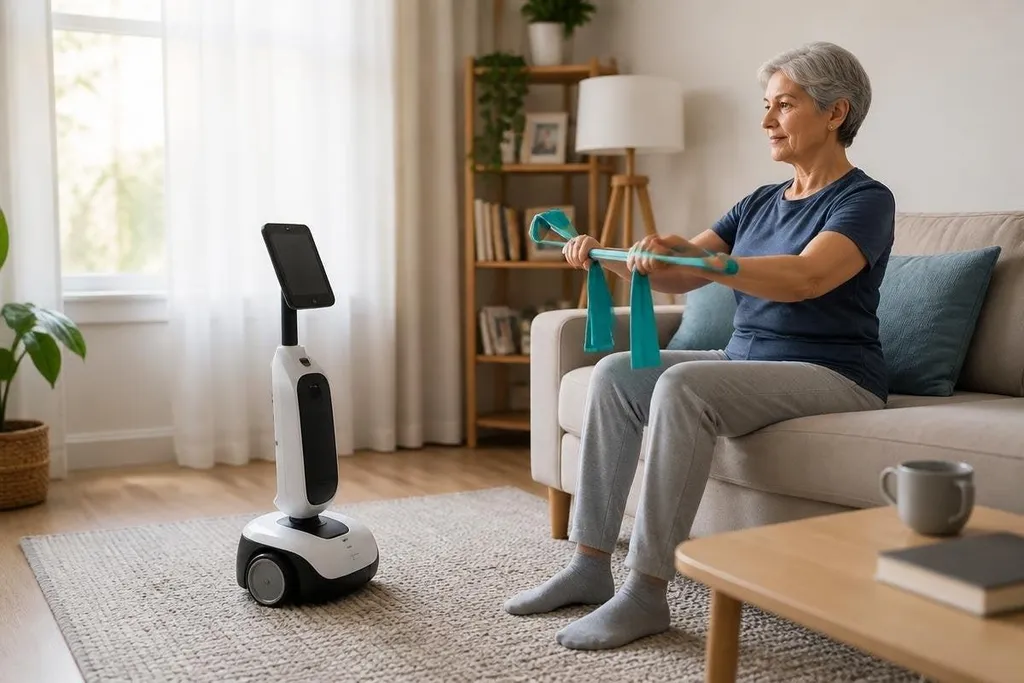
A home robot may remind a patient to complete an exercise, carry a small item, or connect them with a clinician. Those tasks sound useful, but safe recovery depends on more than a robot moving through a house.
- Recovery support could include reminders, movement coaching, and contact with care staff.
- A robot must work around stairs, pets, loose cables, and tired people.
- The buyer needs proof that it helps without adding work for the patient or family.
Where a robot could help
Home recovery often involves repeated tasks. A patient may need to follow an exercise plan, take medicine at set times, or record pain and movement for a care team.
For those tasks, a robot could give a spoken reminder, show an exercise on a screen, or ask the patient to confirm that a task is complete.
The useful part is the link between the reminder and the next action. A prompt that says “walk now” does little if the robot cannot tell whether the patient has stood up, feels dizzy, or needs help. A system that records a missed task could give a clinician a reason to call, but it should not treat a missed task as proof of a medical problem.
A mobile robot could also carry light objects between rooms. That may help a patient avoid repeated trips during the early part of recovery. The safe limit needs to be clear, because a robot that moves unpredictably near someone using a walker creates a new hazard.
Exercise and movement
Some recovery plans depend on repeated movement. A robot with a camera could watch a patient perform an exercise and point out a change in posture. A wearable sensor could measure joint movement and send the result to a care team. These systems may make home sessions easier to check, but the machine still needs a clinician-set plan.
The robot should ask for help when its reading is uncertain. It may misread a coat, poor lighting, a bandage, or a patient who moves slowly. A screen that shows the recorded movement gives the patient and clinician a way to check what the system saw.
Teleoperation is another option. It means a person controls the robot from another location. That could let a therapist check the room or guide an exercise without travelling, but it requires a reliable internet connection and clear consent from everyone in the room.
Reports on home-care robots need named machines, test results, and clear limits. Robot24.com’s home-care robotics reporting gives you those details before the discussion turns to what can go wrong at home.
The limits at home
A hospital has trained staff, fixed equipment, and a layout built for care. A home has none of those guarantees. The robot must deal with narrow doorways, dim rooms, floor mats, stairs, and people who may be weak or confused after treatment.
Privacy also matters. Cameras and microphones can collect information from bedrooms, bathrooms, and family spaces. The buyer should know what the robot records, where it stores the data, who can view it, and how long the records remain available.
A robot cannot replace urgent medical care. If a patient falls, has trouble breathing, develops sudden weakness, or reports severe pain, the system needs a clear route to a person or emergency service. A cheerful voice prompt is not a care plan.
Without a named product, trial, or price, these points are a test plan rather than proof that home recovery robots work. I'd wait for published safety and outcome data before paying for one as a medical service.
A buying and trial checklist
Use this list before a clinic, family, or care provider starts a home trial:
- Set the task: write down the exact job, such as exercise reminders or remote check-ins.
- Name the human contact: record who receives alerts and how fast they must respond.
- Test the floor plan: run the robot near stairs, mats, door thresholds, and the patient’s usual chair.
- Check the data: ask about cameras, microphones, storage, deletion, and access rights.
- Plan failure: decide what happens after a missed response, lost connection, low battery, or fall.
The best first use is a narrow one that a person can check. A reminder robot may be easier to judge than a system that claims to assess recovery, and a failed reminder is easier to fix than a wrong medical warning. The next useful proof is clear: a named device, a measured home trial, and results showing whether patients recover more safely with it than without it.